Quick Summary
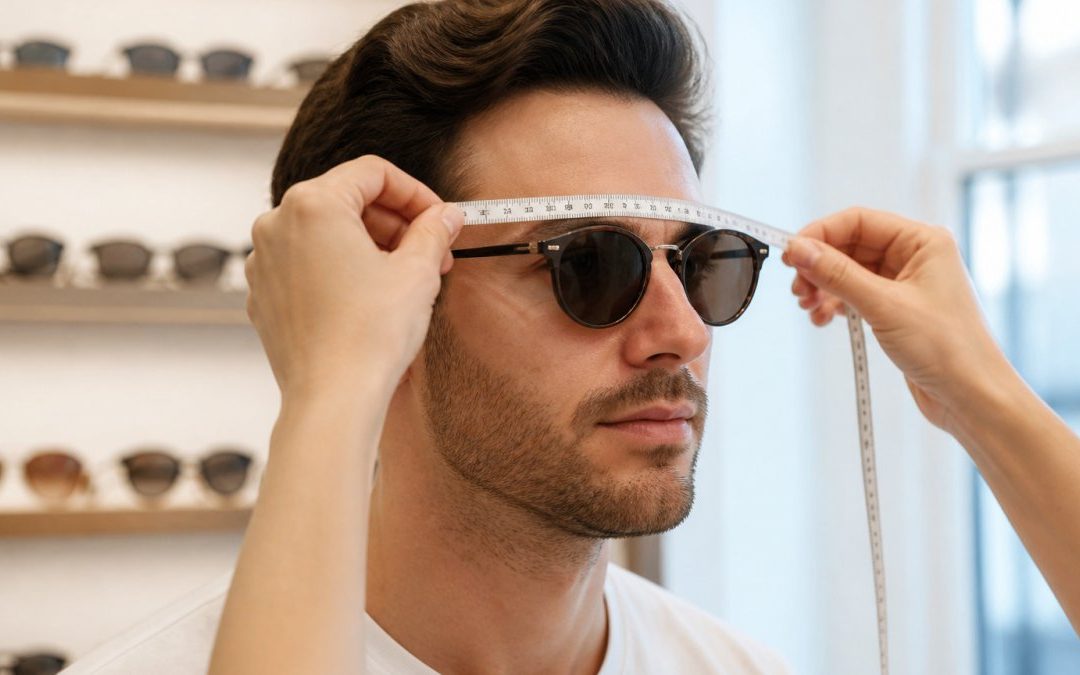
To measure face sunglasses fit, take your face width across the cheekbones and your temple-to-temple distance with a soft tape or millimeter ruler, keeping the tape level. Measure your bridge width at the narrowest point of the nose, then compare these numbers with the frame size printed inside the temple arm.
- Use a soft measuring tape or millimeter ruler, and stand in good light.
- Measure face width horizontally across the widest point, usually the cheekbones.
- Measure bridge width at the narrowest part of the nose, just below the eyebrows.
- Frame sizes appear as lens width, bridge width, and temple length, like 52-18-140.
- Take each measurement two or three times and use the average.
Table of Contents
- Why Face Measurements Matter for Sunglasses Fit
- What You Need Before You Start Measuring
- How to Measure Your Face Width and Temple-to-Temple Distance
- How to Measure Bridge Width for Glasses
- Reading Frame Measurements and Choosing Your Sunglasses Size
- How to Determine Your Face Shape for Sunglasses
- Common Measuring Mistakes and Prescription Lens Considerations
- Using Your Measurements to Shop Kooleyes Sunglasses
- Frequently Asked Questions
Last Updated: October 28, 2026
Learning how to measure face sunglasses fit starts with two numbers: your face width and your bridge width. Get those right, and you can predict fit before you ever try a frame on. You can size your face at home with a few household items and a little patience. Measuring can help you assess how sunglasses may fit.
Sunglasses fit depends on how the frame sits against your face, not just on how it looks in a mirror. A frame that is too wide or too narrow may not feel comfortable. Measuring gives you a starting point when considering frame fit.
Why Face Measurements Matter for Sunglasses Fit
Face measurements can give you a number to compare against the frame size printed inside the temple arm.
Here is what the right fit does for you:
- Stays put on your nose and ears during movement
- Feels comfortable for all-day wear
- Protects your eyes with UV protection
Measuring your face can help you assess sunglasses fit.
What You Need Before You Start Measuring
Gather a few simple tools before you begin. You do not need special equipment.
- A soft measuring tape or a millimeter ruler
- A mirror you can stand in front of comfortably
- A pen or pencil to mark points if you want to re-check later
- A pair of sunglasses or glasses you already like the fit of (optional, but useful as a reference)
Good lighting helps. Stand in daylight or under a bright, even light so you can see where the tape sits against your skin. Keep your hair pulled back from your temples and forehead, since hair can throw off the reading.
If you only have a ruler, you can use it to take your measurements.
How to Measure Your Face Width and Temple-to-Temple Distance
Face width and temple-to-temple distance are measurements you can use when considering frame fit.

Measuring face width:
- Stand facing the mirror with your head level and your eyes looking straight ahead.
- Place the tape or ruler horizontally across your face at the widest point, usually the outer edges of your cheekbones.
- Keep the tape level and flat against your skin. Do not pull it tight.
- Note the number in millimeters.
Measuring temple-to-temple distance:
- Find the point on each side of your head where the temple arm of your glasses would rest, just above the ear.
- Measure from the outer edge of one temple to the outer edge of the other, straight across the back of your head.
- If you are measuring by yourself, a mirror helps you keep the tape level.
A common mistake is measuring at the wrong height. Keep the tape horizontal, not angled up or down. A tilted tape adds length and gives you a number that is too large.
Here is a quick reference for the measurements covered in this section and the steps that go with them.
| Measurement | How to take it | Key point |
|---|---|---|
| Face width | Tape level across cheekbones | Measure in millimeters |
| Temple-to-temple | Outer edge to outer edge over the back of the head | Keep tape level |
| Bridge width | Narrowest part of the nose bridge | Just below the eyebrows |
| Tape tension | Firm but gentle hold | Do not pull tight |
| Repeat measurements | Take each one two or three times | Use the average |
How to Measure Bridge Width for Glasses
Bridge width is the distance between the two lenses at the top of the nose. Read a full walkthrough of bridge width and fit.
- Look straight ahead at the mirror.
- Find the narrowest part of your nose bridge, just below the eyebrows.
- Place the ruler or tape across that spot, from the inner edge of one eye area to the other.
- Note the measurement in millimeters.
Bridge width is one measurement to consider when assessing frame fit.
Reading Frame Measurements and Choosing Your Sunglasses Size
Frame measurements may be shown in a format like 52-18-140. These numbers are: See a full guide on how sunglasses should fit.
- Lens width (52 mm): the width of one lens
- Bridge width (18 mm): the distance between the lenses
- Temple length (140 mm): the length of the arm from hinge to tip
Turning your face measurement into a frame size
Use this sequence to go from your numbers to a shortlist:
A worked example
Suppose you measure a face width of 138 mm and a bridge width of 19 mm. A frame marked 54-18-145 has an estimated total front width of about 54 + 54 + 18 + 8 = 134 mm, close to your face width, so it should sit well at the temples. The 18 mm bridge is 1 mm narrower than your 19 mm measurement, which is within tolerance and may actually give a more secure grip. The 145 mm temple is on the longer side; if you have a smaller head, expect the arms to extend past your ears and consider a 140 mm option instead.
Using a well-fitting pair as your reference
If you already own a pair that fits well, you can use its measurements as a reference when considering another frame.
Keep a note of your face width, bridge width, and the measurements of a pair that fits well as a reference.
Frame measurements describe the frame, not the lenses. A 52 mm lens width does not mean the lens will cover the same area on every face.
How to Determine Your Face Shape for Sunglasses
Face shape can be one consideration when choosing sunglasses. You can also consider your face width, bridge, and whether a frame feels comfortable.
The five common face shapes
- Oval: Longer than wide, with a balanced forehead and jaw.
- Round: Wide cheeks with a soft jawline.
- Square: Strong jaw and forehead.
- Heart: Wider forehead and narrower chin.
- Long: Narrow and long from forehead to chin.
To find your shape, trace the outline of your face in a mirror with a washable marker, or take a straight-on photo and compare its length to its width. Learn which frame styles suit each face shape. Use the result as a guide, not a rule.
Fit adjustments that matter more than shape
Shape and fit are both considerations when choosing sunglasses.
Use face shape and measurements as considerations when choosing sunglasses.
A quick self-check before you buy
You can consider how a frame looks and feels when assessing whether it suits you.
Common Measuring Mistakes and Prescription Lens Considerations
Here are some points to consider when measuring:
- Measuring with a tilted head. Keep your head level and your eyes forward.
- Pulling the tape tight. A firm but gentle hold gives a more accurate reading.
- Ignoring bridge width. A frame can be the right overall size and still slip if the bridge is wrong.
- Forgetting temple length. Short arms can pinch, and long arms can hang loose.
- Measuring only once. Take each measurement two or three times and use the average.
Using Your Measurements to Shop Kooleyes Sunglasses
You can write down your face width, bridge width, and any frame measurements you already trust. Then browse the Kooleyes collection.
Our range covers classic, chic, and sporty styles. If you are unsure which frame suits your face shape, use the shape guide above as a starting point.
Ready to explore the collection? Shop Kooleyes today and choose a style you like. Browse general sunglasses selection
Frequently Asked Questions
How do you measure glasses to fit your face?
You can measure your face width with a soft tape, keeping it level. Lens width, bridge width and temple length are measurements to consider when choosing sunglasses.
How do I check my size for sunglasses?
You can use a pair of glasses that fits well as a reference when considering sunglasses. You can also measure your face width and temple-to-temple distance.
How do I know my face shape for sunglasses?
You can trace your face outline in a mirror or photograph yourself straight on. Note the relative width of your forehead, cheekbones and jawline, and the length of your face. Use this as a guide when considering frame styles.
How wide should sunglasses be on my face?
You can consider how a frame looks and feels when assessing whether it suits you. Check the Kooleyes website for current product information.