Table of Contents
- Why Bridge Width Decides Whether Sunglasses Stay Comfortable
- What the Bridge Measurement Actually Tells You
- How to Measure Bridge Width for Sunglasses at Home
- How to Read Sunglasses Measurements Before You Buy
- How to Measure Glasses Frame Size for a Balanced Fit
- Sunglasses Nose Bridge Fit: Signs You Have the Wrong Width
- 52mm vs 54mm Glasses: Does 2mm Really Change the Fit?
- Lens Protection, Adjustments, and Long-Term Comfort
- Frequently Asked Questions
Last Updated: October 19, 2026
Why Bridge Width Decides Whether Sunglasses Stay Comfortable
Bridge width is the distance between the two lenses of a pair of sunglasses, measured across the piece that rests on your nose.
At Kooleyes, we hear the same complaint from online shoppers: the frames looked great in photos but slid down the nose within minutes.
Here is the good news.
Most guides treat bridge width as a footnote to face shape. We think that is backwards. Face shape tells you what looks good.
What the Bridge Measurement Actually Tells You
The bridge measurement is the gap between your lenses, taken from the inside edge of one lens to the inside edge of the other. It tells you how much nose the frame is built to sit on.
Three numbers describe every pair of sunglasses:
- Lens width: the width of one lens
- Bridge width: the gap between the lenses
- Temple length: the arm length from hinge to tip
The bridge is the one people ignore, and it is the one that decides comfort. A frame with the wrong bridge will slide, pinch, or sit too high.
Bridge width controls where the frame sits on your face. Lens width and temple length control how it looks and feels at the sides. All three matter, but the bridge is the anchor.
How to Measure Bridge Width for Sunglasses at Home
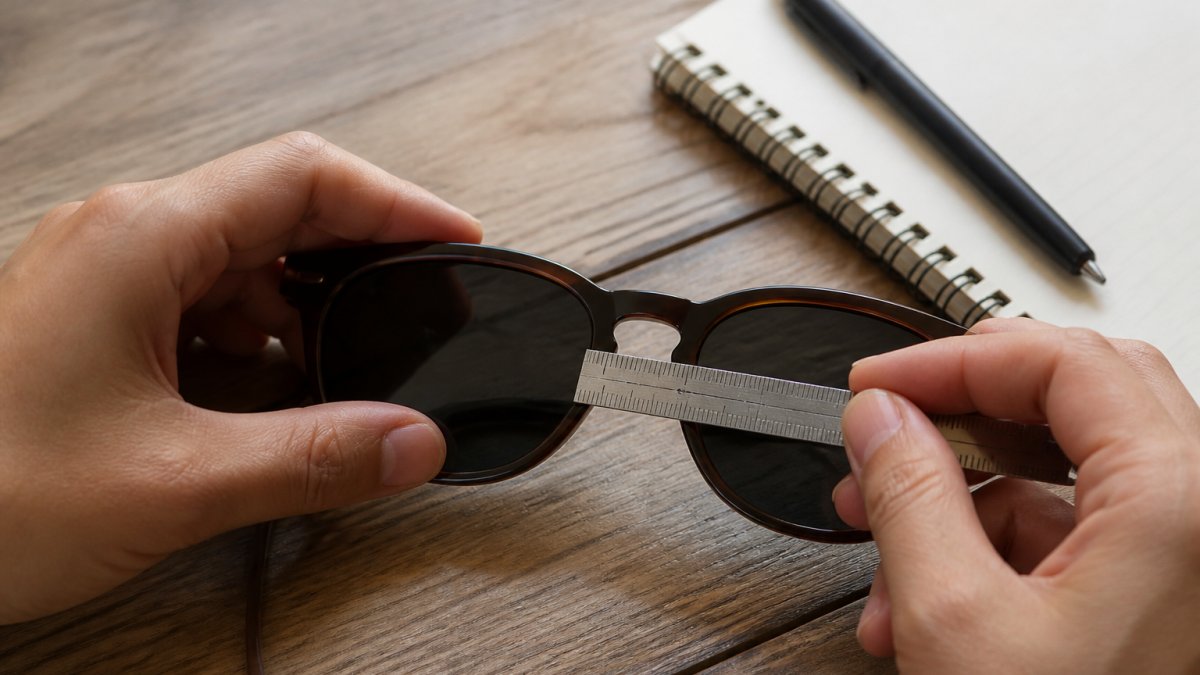
Learning how to measure bridge width for sunglasses takes two minutes and one ruler. You need a millimetre ruler, good light, and either your current frames or your bare nose.
Reading the Number Printed on Your Current Frames
Most sunglasses have three numbers stamped on the inside of the temple arm. They usually look like 52-18-140.
Those numbers mean:
- 52 = lens width in millimetres
- 18 = bridge width in millimetres
- 140 = temple length in millimetres
If the numbers are worn off, measure the bridge yourself. Place the frames face down and run your ruler across the gap between the two lenses.
A common mistake is measuring the nose pads instead of the lens gap. Measure between the lenses, not the pads.
Measuring Your Nose Bridge Without a Frame to Copy
No frames to copy? Measure your nose directly. Hold a ruler flat across the widest point of the bridge of your nose, right where glasses would rest.
Write down that number in millimetres. Add 1-2mm for comfort. That is your target bridge width.
If you are between sizes, size up. A slightly wide bridge is easier to fix with an optician’s adjustment than a bridge that pinches.
How to Read Sunglasses Measurements Before You Buy
Every product page should list three numbers. If it does not, ask before you buy.
Reading sunglasses measurements is simple once you know the order: lens, bridge, temple. The middle number is your bridge width.
| Measurement | Where It Appears | What It Controls | Typical Range |
|---|---|---|---|
| Lens width | First number | Lens size and coverage | 40-62mm |
| Bridge width | Middle number | Nose fit and stability | 14-24mm |
| Temple length | Last number | Arm comfort and grip | 120-150mm |
Compare the middle number to your own measurement. A match within 1mm is ideal. Within 2mm is workable.
Screenshot the measurements of any pair you already love. Those three numbers are your personal fit profile, and they make online shopping far less of a gamble.
How to Measure Glasses Frame Size for a Balanced Fit
Frame size is more than one number. To measure glasses frame size properly, you need the full picture: total frame width, lens width, bridge width, and temple length. The bridge decides stability, but total frame width decides whether the frame looks balanced on your face.
The Four Numbers That Define Frame Size
- Total frame width: the distance from the outer edge of the left lens to the outer edge of the right lens, including the frame rim
- Lens width: the width of one lens at its widest point
- Bridge width: the gap between the lenses
Total frame width is the one people forget. Measure it by placing the frames face down and running a ruler from the outermost left edge to the outermost right edge. This number should roughly match your face width at the temples, measured from temple to temple across the front of your face.
Matching Frame Width to Face Width
A simple rule of thumb: the frame’s total width should be within a few millimetres of your face width at the temples. If the frame is noticeably narrower, it will look pinched and may press on the sides of your head. If it is noticeably wider, it will look oversized and may slide forward because the temples cannot grip behind your ears.
Three quick checks for balanced proportions:
- The frame edges should sit close to the sides of your face without pressing
- Your eyes should sit near the centre of each lens, not at the inner or outer edge
- The bridge should rest on your nose without pressing, and the frame should not sit on your cheeks
Fit Considerations for Different Face Features
Narrow faces: Look for total frame widths in the lower range and bridge widths that match your nose.
Wide faces: Look for total frame widths in the upper range.
Low bridges: A frame with adjustable nose pads gives you more room to fine-tune the fit than a molded acetate bridge.
High prescriptions: Thicker lenses need a frame that holds them securely.
Using Your Existing Glasses as a Fit Profile
The fastest way to size a new pair is to copy the three numbers from a pair you already love. Those numbers are your personal fit profile. Compare the middle number (bridge) first, then total frame width, then temple length. A match within 1mm on the bridge is ideal; within 2mm is workable. For total frame width, stay within about 3-4mm of your existing pair unless you deliberately want a different look.
Trying Frames On or Using a Virtual Try-On Tool
If you cannot try frames in person, use a virtual try-on tool as a rough check for proportion, but do not rely on it for bridge fit. Virtual tools show how a frame looks, not how it grips your nose. Use the measurements to judge fit and the virtual tool to judge style.
Sunglasses Nose Bridge Fit: Signs You Have the Wrong Width
Sunglasses nose bridge fit shows up in your daily habits long before it shows up in a mirror. If you are constantly pushing frames up, the bridge is too wide. If you feel pressure marks after an hour, it is too narrow. The goal is a bridge that contacts the sides of your nose evenly, with no single pressure point and no visible gap.
Watch for these signs:
- Frames slide down when you look down or bend forward
- Red marks or dents on the sides of your nose after 30-60 minutes
- The frame sits too high, above your natural brow line
Why a Wrong Bridge Causes These Problems
A bridge that is too wide lets the frame pivot forward on the nose, so the lenses drop and the temples lose grip behind your ears. A bridge that is too narrow presses the frame into the sides of your nose, which creates pressure marks and can push the frame upward. A bridge that is the right width but the wrong shape (for example, a straight bridge on a low nose) will contact only at two points instead of resting evenly.
Quick Checks Before You Peel Off the Stickers
Try these before you commit to a pair:
- Shake your head gently. Frames should stay put without you squinting to hold them.
- Look down at your phone for 30 seconds. No sliding.
- Smile wide and raise your eyebrows. No pinching at the nose and no lifting of the frame.
Can You Fix a Bridge That Is Slightly Off?
Sometimes. A small adjustment at the bridge or temples can close a 1-2mm gap or relieve a light pressure point. An optician can bend metal bridges and adjust acetate frames with heat. What an optician cannot do is stretch a bridge that is fundamentally 4-5mm too narrow, or shrink one that is too wide. If the bridge is off by more than about 2mm, adjustment will not solve it.
Do not try to bend acetate or metal frames at home. Acetate can snap and metal can crack at the hinge. A professional adjustment takes minutes and is usually free at optical shops.
When to Return and What to Expect
If a new pair slides or pinches after a professional adjustment, return it. Check the return policy before you buy, especially for online purchases where you cannot try the bridge in person.
A common pattern among online shoppers is to blame the lens or the style when the real issue is the bridge. If you know your bridge width before you order, you can skip most of this troubleshooting entirely.
52mm vs 54mm Glasses: Does 2mm Really Change the Fit?
Yes, 2mm changes the fit, but usually in lens width, not the bridge.
A 2mm jump in lens width makes the frame feel noticeably bigger. It adds coverage and presence.
A 2mm jump in bridge width is subtler but matters more for comfort. That small gap decides whether the frame grips or slides.
Our advice: match the bridge closely, then pick lens width based on the look you want.
Lens Protection, Adjustments, and Long-Term Comfort
Fit is only half the job. The other half is what the lens does for your eyes.
Look for full UV protection. The FDA guidance on sunglasses and UV safety explains why UV400 coverage matters for long-term eye health.
Polarized lenses cut glare from water, roads, and snow. That matters for drivers, cyclists, and anglers.
Long-term comfort comes down to three habits:
- Store frames in a case to protect the hinges
- Clean lenses with a microfibre cloth, not your shirt
- Have an optician adjust the fit once a year
If a pair fits well but sits slightly off, a small adjustment at the bridge or temples usually fixes it.
For anyone shopping with a prescription, check that the bridge matches your existing glasses. The American Optometric Association’s guidance on eyewear notes that a stable, well-fitted frame keeps lenses aligned with your eyes.
At Kooleyes, our polarized and UV-protective frames are built for exactly this: all-day comfort across driving, hiking, and everyday wear.
Frequently Asked Questions
How do I know if my sunglasses bridge is too wide or too narrow?
A bridge that is too wide lets the frames slide down your nose, especially when you look down, and you may see a gap between the frame and the sides of your nose. A bridge that is too narrow pinches, leaves red marks after 20 minutes, and can push the lenses too close to your lashes. Check by looking straight ahead in a mirror: the frame should touch evenly on both sides of your nose without pressure points. If you feel constant readjusting or tenderness, the bridge width is off.
What is a good bridge width for sunglasses?
There is no single universal number. Most adult sunglasses fall between 14mm and 24mm, and the right bridge width depends on your nose shape and the frame’s total width. A better approach is to measure a pair that already fits you well and match that number. If you are between sizes, a slightly wider bridge with adjustable nose pads is easier to correct than a bridge that pinches. Kooleyes lists bridge measurements on product pages so you can compare before ordering.
Should I get 52 or 54 glasses?
The 52mm vs 54mm glasses question usually refers to lens width, not bridge width, and 2mm is a small difference. A 52mm lens suits narrower faces or anyone who wants a closer, more compact look; 54mm gives a slightly broader field of view and more coverage. The bridge width matters more for comfort. If a 52mm frame pinches your nose, moving to 54mm will not fix it unless the bridge measurement also increases. Always compare both numbers.
Can I measure my nose bridge for sunglasses at home?
Yes. Use a ruler or tape measure and place it across the bony part of your nose where the frame would rest, measuring from the inner edge of one eye socket to the inner edge of the other. This gives a rough bridge width. For a more accurate result, measure the bridge of a pair of glasses that already fits comfortably and use that number. Write it down and compare it with the bridge measurement on any product page before you buy.
Bridge width is the number most shoppers skip, and it is the one that decides whether sunglasses stay put. Measure your current frames, note the middle number, and compare it before you buy. At Kooleyes, we stock polarized and UV-protective styles for every face and activity, so you can match your fit profile to a frame that looks as good as it sits. Shop Kooleyes and find your pair with confidence.