
Last Updated: November 2, 2026
Quick Summary
Affordable UV sunglasses can protect kids’ eyes, but only when the label names a real standard such as UV400 or 100% UVA/UVB. Clouds do not block UV rays, so protection matters even on grey days. Check the standard in writing before you compare price, color or style.
- Clouds do not block ultraviolet rays, so kids need UV protection on grey days too.
- Look for UV400 or 100% UVA/UVB stated in writing, not just vague words like UV-safe.
- Polarization reduces glare but does not add UV protection, so check the UV rating separately.
- Frames should sit close to the face without gaps, since gaps let UV light in at the sides.
Table of Contents
- Why Kids Need UV Protection Even on Cloudy Days
- How to Verify UV400 and 100% UVA/UVB Claims
- Best Sunglasses for Toddlers and Young Children
- Kids Polarized Sunglasses: Are They Worth the Extra Cost?
- Durable Sunglasses for Kids: Frames, Straps and Replacement Value
- Fit Guidance by Age and Face Shape
- Affordable Picks Compared: Pricing, Pros and Cons
- Choosing Your Child’s First Pair Today
- Frequently Asked Questions
Why Kids Need UV Protection Even on Cloudy Days
Clouds do not block the sun’s ultraviolet rays, and children’s eyes are more vulnerable to them than adults’ eyes are, so affordable UV sunglasses matter even on grey days (the WHO). Many parents assume a grey sky means safe skin and eyes, but UV exposure can still build up on overcast days. This guide helps parents separate sunglasses that protect from those that only look the part. The short answer: affordable UV sunglasses for kids can be genuinely protective, but only if the label is backed by a real standard.
Children spend more time outdoors than adults, and their lenses let in more light. That makes UV protection a practical need, not a fashion choice. The sections below explain how to check the claim, which features matter, and where the cheaper options fall short.
How to Verify UV400 and 100% UVA/UVB Claims
Look for UV400 or 100% UVA/UVB protection on the product listing, then confirm it is stated in writing rather than implied by the frame style. A label that says “UV protection” with no standard attached tells you very little. Ask the seller which standard the lenses were tested against and whether that testing was independent.
Check the lens packaging or product page for the test standard, and be cautious of vague wording like “UV-safe” or “UV-blocking” with no percentage or rating. You can also ask the seller for documentation. Reputable brands will usually answer plainly.
For a step-by-step method you can use in a store or online, see our guide on how to check UV400 protection on your sunglasses.
Best Sunglasses for Toddlers and Young Children
Toddler sunglasses need a secure fit more than anything else. Frames should be flexible, lightweight and sit without pinching behind the ears.
Youth and toddler sizes differ in width and temple length, so a pair sized for a six-year-old may slide off a toddler. Check the age range printed on the listing and treat it as a guide, not a strict rule.
Sizing by age: what actually changes
Most children’s sunglasses are sold in three broad bands: baby (roughly 0-2 years), toddler (roughly 2-5 years) and youth (roughly 5-10 years). The differences that matter are frame width, temple length and bridge width, not the color or character on the side.
A practical way to check fit without a ruler: the frame should span the width of the face without extending past the temples, the bridge should rest on the nose without pressing, and the temples should reach the ears and curve gently behind them. If the frame slides down when your child looks down, it is too wide or too heavy.
Measure an existing pair that fits well, frame width, lens width, bridge width and temple length, and compare those numbers to the listing. This is more reliable than the age range alone, especially for children between sizes.
Face shape and frame style
Round faces tend to suit angular or rectangular frames, while angular faces often balance better with rounded or oval shapes. This is comfort guidance, not a rule; the priority is that the frame stays close to the face so UV light does not leak in at the sides or top. For broader guidance on matching frames to face shape, read how to choose sunglasses for face shape. If you are shopping for a smaller face specifically, see our small face sunglasses recommendations.
Toddler-specific features worth paying for
- Retention strap: the cheapest way to keep a pair on a toddler and prevent loss during play.
- Flexible frame material: rubberized or memory-plastic frames survive bending and drops better than rigid plastic.
- Impact-resistant lenses: reduce the chance of lens cracking during falls.
- Wrap-style temples: help block side glare and keep the frame seated during movement.
Avoid adult-sized frames scaled down only in color. A pair that gaps at the temples or slides down the nose lets in UV and usually ends up lost or discarded.
Kids Polarized Sunglasses: Are They Worth the Extra Cost?
Polarized lenses reduce glare from water, snow and roads. For children who play near lakes, beaches or snow, that glare reduction can make outdoor play more comfortable. Polarization does not add UV protection on its own, so treat it as a comfort feature and check the UV rating separately.
Many families decide the extra cost is worthwhile for regular water or snow activities, and less so for occasional use.
Durable Sunglasses for Kids: Frames, Straps and Replacement Value
Children are hard on eyewear. A durable pair usually has a flexible frame, impact-resistant lenses and a sturdy hinge.
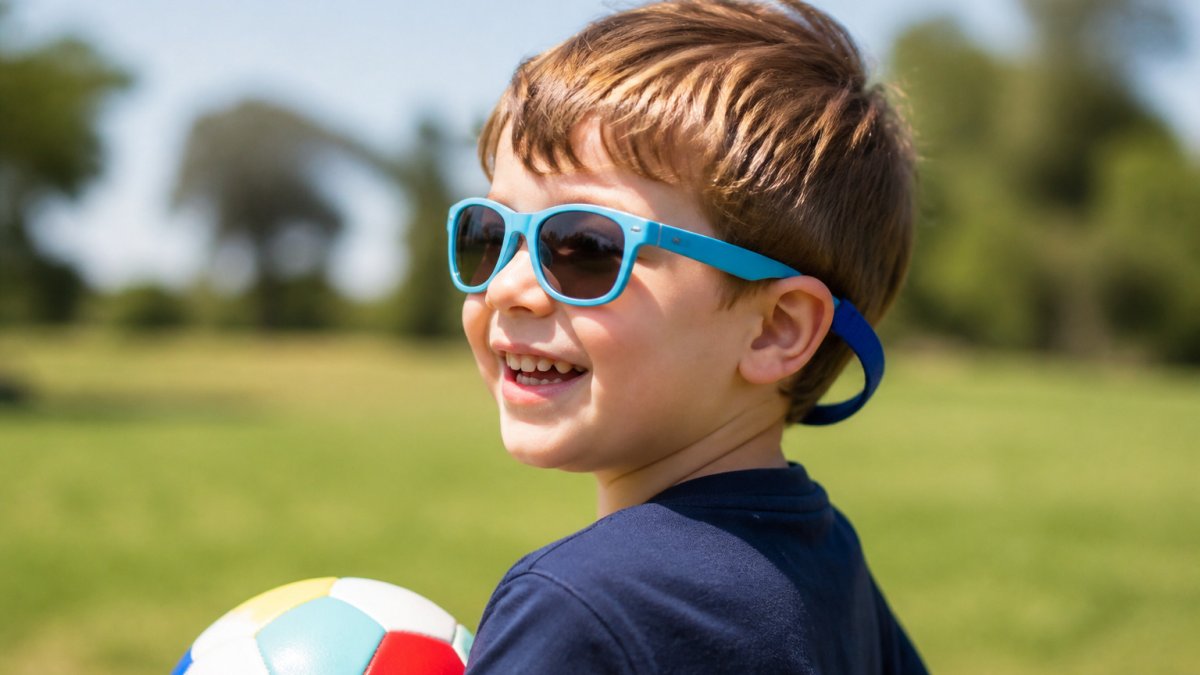
Replacement value matters too. Look for a clear warranty or replacement policy before you buy.
Check the replacement terms on the seller’s page before you need them.
!A young child in a park wearing colorful flexible-frame sunglasses with a retention strap, smiling while playing outdoors
Fit Guidance by Age and Face Shape
Fit matters for both comfort and protection. Gaps at the sides or top let UV light in, so frames should sit close to the face without pinching. Look for a bridge that rests comfortably on the nose and temples that stay in place during movement.
Smaller faces need smaller frames, and many adult-sized pairs will not fit a young child properly. For broader guidance on matching frames to face shape, read how to choose sunglasses for face shape. If you are shopping for a smaller face specifically, see our small face sunglasses recommendations.
Affordable Picks Compared: Pricing, Pros and Cons
The table below compares several kids’ sunglasses options named in the research. Prices are shown only where a source listed them, and current prices may have changed, so check the seller’s site before buying. This section focuses on what the keyword actually asks: affordable UV protection, verified claims and long-term value rather than sticker price alone.
| Option | Listed Price | UV Claim | Polarized | Best For |
|---|---|---|---|---|
| RIVBOS Kids Polarized | About $10 (review listing) | UV protection stated | Yes | Low-cost pairs |
| Jonas Paul Kids | $39 (sale price shown) | 100% UV protection | Not stated | Multiple color choices |
| MiniShades | Not shown in research | 100% UV protection | Yes | Polarized pairs with UV |
| Roshambo Junior Shades | Not shown in research | Exceeds international standards per listing | Yes | Active kids ages 5-10 |
Check the current price, the UV standard and the warranty on the seller’s own page before buying.
How to judge affordability beyond the sticker price
A cheap pair that breaks or is lost twice a season can cost more than a sturdier pair bought once. When comparing options, divide the price by the months you expect the pair to last, and factor in whether a warranty or replacement policy covers loss or damage. A slightly higher upfront price with a clear guarantee is often the lower-cost choice over a year.
Affordability is not the same as the lowest price. The best value is the pair with a verified UV claim, a secure fit and a replacement policy that matches how often your child loses or breaks things.
Verify the UV claim before you compare price
A low price is only meaningful if the lenses actually protect. Look for UV400 or 100% UVA/UVB protection stated in writing, and ask the seller which standard the lenses were tested against. Vague wording like “UV-safe” or “UV-blocking” with no percentage or rating tells you very little. For a step-by-step method you can use in a store or online, see our guide on how to check UV400 protection on your sunglasses.
Shipping, returns and replacement terms
Price comparisons should include shipping and return costs, which can erase a small savings on a low-priced pair. Check whether returns are free, whether the warranty covers accidental damage, and how long the replacement process takes. A pair with a lifetime guarantee and independent UV testing may be the better value even at a higher listed price.
When polarized lenses are worth the extra cost
Polarized lenses reduce glare from water, snow and roads, which can make outdoor play more comfortable. Polarization does not add UV protection on its own, so check the UV rating separately. For children who spend regular time near water or snow, the extra cost is often worthwhile; for occasional use, a non-polarized pair with a verified UV claim is usually sufficient.
Choosing Your Child’s First Pair Today
Start with the UV label. Confirm a specific standard, such as UV400 or 100% UVA/UVB, before you look at color or style. Then check fit: the frame should stay put during play and sit without gaps.
Next, decide whether you need polarization. If your child spends time near water or snow, the glare reduction is worth considering. Finally, weigh durability and replacement terms against price, since a sturdy pair with a clear warranty often costs less over time.
When you are ready to compare frames, browse Kids UV sunglasses for bright, busy days for guidance on choosing protective, comfortable frames your child will wear.
Frequently Asked Questions
What should I look for in UV-protective sunglasses for kids?
Look for a label that explicitly states 100% UVA and UVB protection or UV400, which blocks light up to 400 nanometers. Check that the lenses are impact resistant and that the frame is flexible enough to survive being dropped or sat on. A secure strap or retention band helps keep the pair on an active child. Tints and lens darkness do not indicate UV protection, so a dark lens without a UV label offers no guarantee. When a seller cannot confirm the protection rating in writing, treat the claim as unverified and choose another pair.
Are polarized sunglasses better for children?
Polarized lenses reduce glare from reflective surfaces such as water, snow, and wet roads, which helps with comfort during beach days, cycling, and fishing trips. Polarization does not add UV protection, so a polarized lens still needs a UV400 rating. Many affordable kids’ pairs include polarization, but the price difference varies by seller, so compare the listed price against what the pair actually includes. For children who mostly play in shade or indoors, standard UV-blocking lenses are usually sufficient.
How should kids’ sunglasses fit?
Kids’ sunglasses should sit level on the nose bridge without sliding down when the child looks down. The temples should rest comfortably behind the ears without pinching. Lenses should cover the eyes and the area around them so light cannot enter from the sides. Toddlers often need a strap because they remove glasses frequently. Because face shapes vary, check the size guide and measure the frame width against the child’s face where possible.
What are the best affordable sunglasses for toddlers?
For toddlers, prioritize a flexible frame, a secure strap, and a verified UV400 label over brand names. Prices change frequently, so confirm the current price and UV rating on the seller’s page before buying. Toddler pairs should also be cleaned regularly and checked for loose hinges.