Quick Summary
To check UV400 protection, first look for a UV400 or 100% UVA and UVB label on the lens, arm, hang tag or box. If no label is found, a home test with a UV flashlight can screen for obvious gaps, but only an optician’s lens-testing equipment can confirm the rating for a pair that matters.
- Look for UV400 or 100% UVA and UVB on the lens, arm, hang tag or box.
- Darkness does not indicate UV protection; a clear lens can block UV completely.
- Test with a 365 nm UV flashlight in a dim room, never looking into the beam.
- Home flashlight tests only screen for obvious gaps and cannot prove UV400 performance.
- Ask an optician to measure UV transmission for driving or high-value lenses.
Table of Contents
- What UV400 Protection Means and Why It Matters
- Step 1 and 2: Read the Label and Packaging for UV400 or 100% UVA/UVB
- Step 3 to 5: Test at Home With a UV Flashlight or Meter
- Step 6: Ask an Optician to Measure Your Lenses
- Polarized and UV400 Are Not the Same Thing
- Standards, Coatings and Fit: What Else Affects Eye Protection
- Choosing Kooleyes Sunglasses With Confirmed UV Protection
- Frequently Asked Questions
What UV400 Protection Means and Why It Matters
Last Updated: October 30, 2026
UV400 is a labelling term that means a lens blocks ultraviolet light up to 400 nanometres, which covers both UVA and UVB rays.
Most people assume a dark lens means strong protection. That is one of the most common mistakes. A lens can look almost black and still let harmful UV light through, while a clear lens can block it completely.
UVA vs UVB: What Each Ray Does to Your Eyes
UVA rays reach deeper into the eye and are present at steady levels throughout the day, even on cloudy days. UVB rays are strongest in the middle of the day and mainly affect the surface of the eye and the skin around it. Good sunglasses block both.
- UVA: longer wavelength, penetrates deeper, present year-round
- UVB: shorter wavelength, strongest midday, affects the eye surface
- UV400: blocks both types up to 400 nm
Why Darkness Is Not a Reliable Guide
Lens tint controls how much visible light you see, not how much UV gets through. A dark lens with no UV coating can make your pupils open wider, letting more UV reach the eye. That is why the label matters more than the colour.
Step 1 and 2: Read the Label and Packaging for UV400 or 100% UVA/UVB
Start with the easiest check. Look for a label on the lens, the arm, or the tag. Look for “UV400” or “100% UVA and UVB protection.” If you have the box or the tag, check the packaging too.
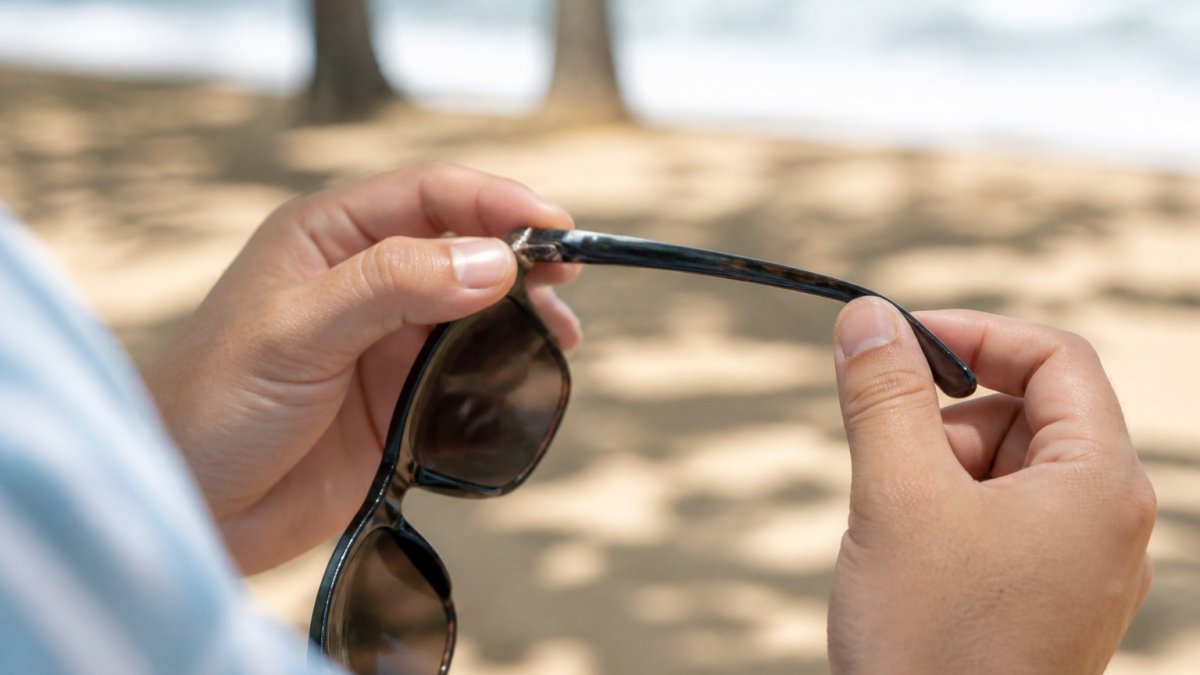
- Look on the lens or arm: Many frames print the protection level near the hinge.
- Check the hang tag and box: Retailers often list the UV rating here.
- Be wary of vague claims: Words like “UV protective” without a standard are not a clear guarantee.
If you cannot find any UV label, the lens may still be protected, but you cannot confirm it from the product alone. Move on to the testing steps below.
Step 3 to 5: Test at Home With a UV Flashlight or Meter
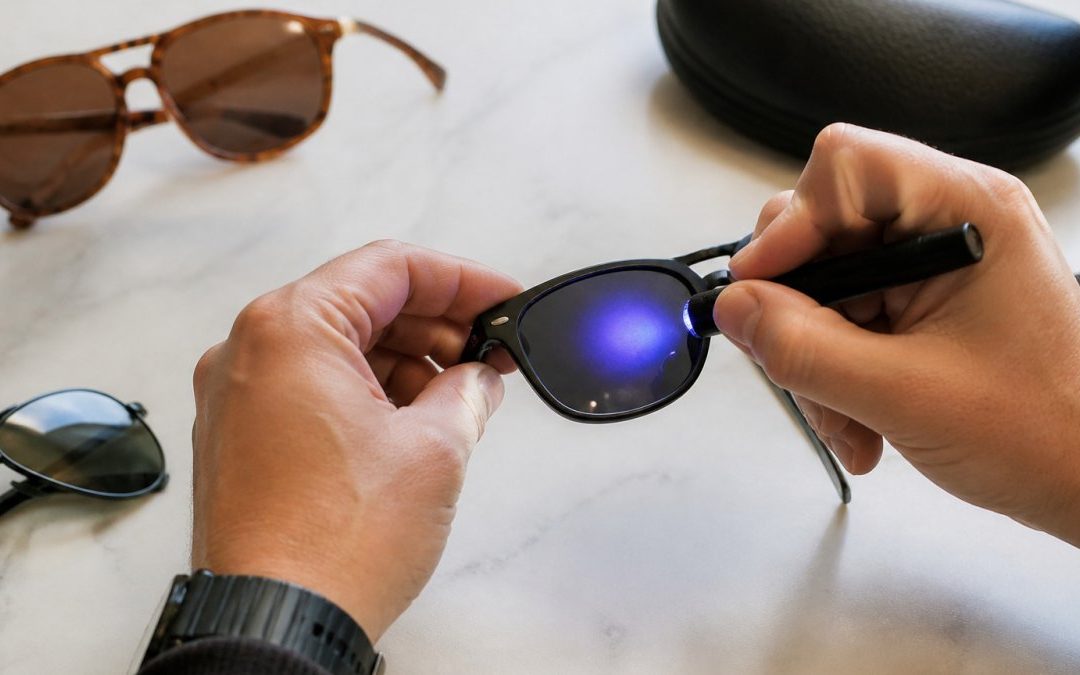
When the label is missing or unclear, a home check can tell you whether a lens absorbs UV light, but it cannot certify UV400 performance. The difference matters: a flashlight demo shows absorption at one wavelength, while UV400 is a claim about blocking everything up to 400 nm. Use the protocol below to get a meaningful signal, then read the reliability notes before you draw conclusions.
Equipment You Actually Need
- UV flashlight: Look for one rated 365-395 nm. A 365 nm light is preferable because it sits closer to the UVA range that lenses are designed to block; a 395-400 nm light can produce a misleadingly strong result on lenses that only partially block UVA.
- Known reference lens: A clear prescription lens or a pair with a printed UV400 label gives you a baseline for comparison.
- Dim room: Ambient visible light makes fluorescence and transmission differences harder to see.
A Safe Testing Protocol, Step by Step
- Work in a dim room and put on UV-blocking eyewear if you are testing multiple pairs, never look into the flashlight beam.
- Hold the flashlight about 2-3 cm from the front of the lens, beam perpendicular to the lens surface.
- Look at the back surface of the lens from an angle, not straight into the beam. You are checking whether UV-induced fluorescence or visible purple light passes through.
- Repeat with the reference lens under the same conditions. A protected lens should show noticeably less transmission or fluorescence than an unprotected clear lens.
- Test both lenses and, if possible, the lens edges and any prescription insert, since coatings can be uneven.
Never look directly at a UV flashlight, and do not hold the light against your eye or a child’s eye. UV flashlights are not toys, and prolonged direct exposure can harm the eye.
How to Interpret What You See
- Strong reduction versus the reference lens: Consistent with UV absorption, but not proof of UV400.
- Little or no difference: The lens is probably not UV-protective, or the coating is failing.
- Mixed results across the lens: Suggests a partial or uneven coating; treat the pair as unverified.
How Reliable Are Consumer UV Flashlights and Meters?
Consumer UV flashlights are demonstration tools, not measuring instruments. Most emit a narrow band around their rated wavelength, so they test one slice of the UV spectrum rather than the full 280-400 nm range that UV400 covers.
Consumer UV meters vary widely in calibration and sensor quality. Inexpensive units often have wide tolerances and can drift with battery level and temperature.
Home testing is best used to rule out obviously unprotected lenses. If a pair matters, driving, high-altitude travel, or daily outdoor work, confirm with an optician’s lens-testing equipment rather than relying on a flashlight or budget meter.
The home test steps are easier to follow when the key points are laid out side by side.
| Item | Value | Note |
|---|---|---|
| UV flashlight rating | 365-395 nm | 365 nm is preferable, closer to the UVA range |
| Light distance from lens | 2-3 cm | Beam held perpendicular to the lens surface |
| Test lenses in | Dim room | Ambient light makes differences harder to see |
| Flashlight safety | Never look directly at beam | Do not hold it against your eye or a child’s eye |
| Flashlight reliability | One narrow band | Tests one slice of the 280-400 nm range |
| Home test result | Screening only | Not proof of UV400 performance |
Step 6: Ask an Optician to Measure Your Lenses
For a precise answer, take the sunglasses to an optician or optical professional. Many optical shops have lens-testing equipment that measures UV transmission directly. This is the most dependable option for an uncertain pair, and it is worth the small effort if the sunglasses matter for driving or long outdoor days.
Polarized and UV400 Are Not the Same Thing
People often mix up these two terms. Polarized lenses reduce glare from flat surfaces like water and roads. UV400 describes how much ultraviolet light the lens blocks.
When you shop, check both features separately. If you want polarized lenses with confirmed UV protection, browse our polarized driving sunglasses. For a deeper comparison, read our guide on polarized vs non-polarized lenses.
Standards, Coatings and Fit: What Else Affects Eye Protection
A UV400 label is a claim about the lens, but the protection you actually get depends on where the UV blocking comes from, how the lens is documented, and how well the frame covers your eyes. This section covers the parts most guides skip.
Standards and Certification: What UV400 Claims Mean in Practice
UV400 is a performance claim, not a single universal certification. In practice, it means the lens is designed to block ultraviolet radiation up to 400 nm, which covers the UVA and UVB ranges relevant to eye health. Different markets reference different standards, for example, the European EN ISO 12312-1 standard for sunglasses and the US ANSI Z80.3 standard, and a product may carry a UV400 label without an independent test report.
When you assess documentation:
- Look for a specific standard reference on the tag or packaging, not just the words “UV400.”
- Check whether the claim is on the lens, the frame, or only the marketing copy. A claim buried in a product description is weaker than one printed on the temple.
- Ask for a test report if you are buying prescription or high-value lenses; optical labs can usually provide transmission data.
A UV400 label tells you what the manufacturer claims. It does not tell you who verified it. For everyday sunglasses that is usually fine; for prescription lenses, ask your optician for the transmission specification.
Lens Material Versus Coating: Where the Protection Comes From
UV blocking can come from the lens material itself, from a coating applied to the lens, or from both.
- Material-based protection: Polycarbonate and Trivex lenses inherently absorb most UV light, which is one reason they are common in sports and children’s eyewear. CR-39 and other standard plastic lenses typically need a UV coating to reach UV400 performance.
- Coating-based protection: A UV coating or hard-coat stack applied to the lens surface provides the blocking. Coatings can degrade with scratches and aggressive cleaning, so a scratched lens may no longer meet its original claim.
- Prescription lenses: Ask specifically for UV400 or 100% UV protection when ordering. Many labs offer it as an add-on, and the protection may sit in the coating rather than the base material.
A practical check: if a lens is scratched or delaminating, treat its UV protection as uncertain regardless of the original label.
Fit and Coverage: The Protection the Label Does Not Cover
Even a perfectly UV400 lens only protects the light that passes through it. Gaps around the frame let UV reach the eye from the sides, top, and bottom.
- Wrap and close-fitting frames reduce peripheral exposure, which matters for driving, skiing, and water sports.
- Large lenses and brow coverage limit light entering from above.
- Adjustable nose pads and temple fit keep the lens in the right position; a slipping frame exposes more of the eye.
If you are choosing between two UV400 pairs, the one with better coverage gives you more real-world protection. To check how well a frame covers your eyes, you can measure your face for sunglasses.
A Decision Tree for Unlabelled or Uncertain Sunglasses
- No label anywhere and no documentation? Treat the pair as unverified. Use it only as a fashion accessory, not for extended sun exposure.
- Label present but vague (“UV protective”)? Look for a standard reference or ask the seller for transmission data. If neither is available, treat it as unverified.
- Home flashlight test shows little difference from a clear reference lens? Assume the lens is not UV-protective and replace it for outdoor use.
- Home test looks promising but the pair matters for driving or daily wear? Take it to an optician for a transmission measurement.
- Prescription or high-value lenses? Request the UV transmission specification from the optical lab before you rely on the claim.
For a broader view of why this matters, read the importance of UV protection in sunglasses. If you want to go deeper on confirming UV400 claims, our complete guide to telling if sunglasses are UV400 covers the same ground in more detail.
Choosing Kooleyes Sunglasses With Confirmed UV Protection
When you shop with Kooleyes, look for the UV400 or 100% UVA and UVB label on the product page and packaging. Check the label first, then choose the frame that suits you best.
For current prices and the latest styles, visit the Kooleyes website.
Frequently Asked Questions
Does UV400 mean 100% UV protection?
UV400 means the lenses absorb ultraviolet light up to a wavelength of 400 nanometres. That range covers both UVA and UVB, so a lens labelled UV400 or 100% UVA and UVB protection blocks essentially all UV light that reaches the eye. The label is a manufacturer claim, so check that it appears on the product tag, packaging or lens marking. If you want confirmation beyond the label, an optician can measure the lenses.
How can I test my UV glasses at home?
A UV flashlight or UV meter can give a rough indication. Shine a UV light through the lens onto a UV-sensitive surface such as a banknote with security strips or a UV-reactive card, and compare with and without the sunglasses. Consumer devices vary in accuracy and cannot measure exact protection levels, so treat the result as a screening check rather than proof. A negative or unclear result is a reason to ask an optician to test them.
Can an optician test sunglasses for UV protection?
Yes. Opticians and optical professionals can measure UV absorption with a calibrated lens tester, which gives a more reliable result than consumer tools. Bring the sunglasses and, if you have it, the packaging or product details. Many optical shops offer this check at low cost or for free, and it is worth doing for prescription lenses, second-hand pairs or any pair where the label is missing or unclear.
Do dark lenses block more UV than light lenses?
No. Lens darkness reflects how much visible light is reduced, not how much UV is blocked. A very dark lens without UV absorption can cause the pupil to widen, letting more harmful UV reach the eye. Always check the UV400 or 100% UVA and UVB label instead of judging protection by tint depth.